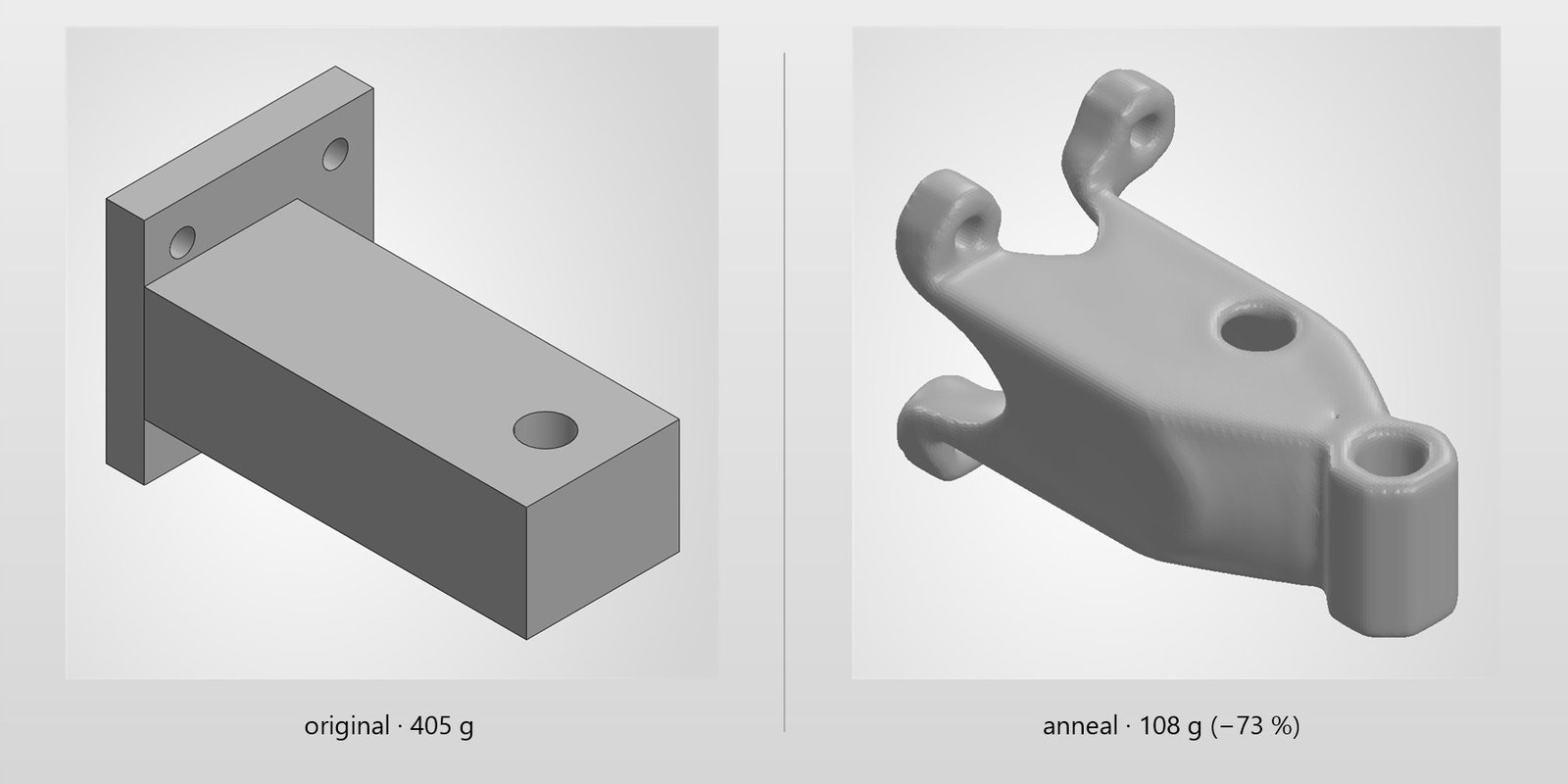
Anneal is a tool I’m building that makes an existing part lighter and stiffer. You open a model, click where the part is held and where it’s loaded, set a goal, and Anneal removes the material that isn’t carrying load. It then rebuilds a smooth, printable surface and checks the new part before you print it.

The example bracket that ships with Anneal: 405 g down to 108 g (−73 %), still within its 0.3 mm deflection limit with a safety factor of 2.7 on yield.
why i built it
Most of what I design ends up 3D printed, from robot brackets to motorsport parts, and most of those parts carry more material than they need to. Topology optimisation can fix that, but the usual tools are expensive, tied to one CAD package, or stop at a rough mesh you can’t print. I wanted something I could point at any STEP or STL file and get a part I could actually print.
the workflow
- Open a part: STEP, STL, OBJ or 3MF.
- Mark it up: click on the model to pick holes, flat faces or patches, and mark each as held or loaded. Anneal fits a cylinder to a hole or a slab to a face, so you don’t need to define geometry by hand.
- Set the goal: the material and process, how stiff the part has to be, and the safety factor you need.
- Run: Anneal optimises, builds the surface, re-checks the finished part and writes a report. Every run is saved, so you can compare versions by mass or stiffness and note what you printed and how it tested.
It works three ways: as a desktop app, in the browser, or from the command line with a spec file, and all three write the same files.
how it works
- Solve: the part is turned into voxels and solved with a finite-element model, using a multigrid-preconditioned solver so it runs on an ordinary PC with no GPU.
- Optimise: a density-based (SIMP) optimiser removes material that doesn’t carry load. Density filtering, penalty continuation and Heaviside projection push the result towards a clean solid rather than a cloud of half-dense voxels, and it can handle several load cases at once.
- Rebuild and re-check: the result is turned into a smooth, watertight surface, then voxelised and solved again as built. It searches for the lightest version that still meets the stiffness limit.
printability built in
A part that’s strong enough is no use if it can’t be made, so after every run Anneal checks the result against the chosen process:
- Build volume: does it fit the machine, in the build direction?
- Minimum wall and hole size: are the thinnest members and smallest holes printable?
- Overhangs: how much needs support, and which of the six build directions needs the least?
- Closed cavities: powder processes can’t have trapped voids.
- Layer strength: is the tension across the layers safe, given that printed parts are weaker in Z?
It ships with profiles for FDM, SLS and metal powder-bed fusion (LPBF), and materials from PLA and PETG to nylon PA12, aluminium AlSi10Mg, titanium Ti64 and 316L steel. You can add your own materials and printers to a personal library that updates never overwrite.
the bracket, in detail
I ran the example bracket at normal resolution on my PC. It took about 33 minutes:
| mass | 405 g → 108 g (−73 %) |
| max deflection | 0.27 mm, limit 0.3 mm |
| safety factor on yield | 2.73, limit 2.0 |
| layer strength | safety factor 9.85 across the layers |
| thinnest member | 3.1 mm, minimum 0.6 mm |
| overhangs | 20 % of the surface needs support; building along +X instead cuts that to about a fifth |
honest limits
Anneal is a design tool, not a certification tool. It assumes linear, static loads with no buckling, fatigue or impact; FDM parts are weaker across their layers than the datasheet suggests; and bolted holes are modelled as fully fixed, which is stiffer than a real joint. Critical parts still need an independent check.
what’s next
- Lattice infill through a PicoGK geometry backend, with lattice density graded from the optimised result instead of simply thresholded.
- Loads from simulated events like drops and landings.
- Overhang and minimum-size constraints inside the optimiser, so parts come out self-supporting.
I’m using it on parts for my own robots, starting with OB15. The code is open source: github.com/ImpurestTadpole/anneal.